

Talking Street
Come and join me as I talk about how I shoot street.
Thursday 30th November - an evening opportunity to enjoy The Seeing Eye exhibition at Farnham Pottery - then sit back and listen as I share my philosophy and techniques for street photography, with opportunities to view recent work.
For more info: The Seeing Eye


Camera settings for street photography - The Fastest Gun in the West
What are the best camera settings for shooting street photography?

I can't remember which cartoon Quick Draw McGraw came from (turns out it was his own show www.youtube.com/watch?v=X9Nh7xIh8Og), but I'm often reminded of him when I'm in the zone for a good day shooting candid photography on the streets. Part of the appeal of street photography for me is the fast nature of it. It reminds me of hunting - not that I have ever hunted or ever plan to. I'm sure that the same basic instincts, of going undetected and making the most of the element of surprise, apply to both street photography and hunting. After all, we don't call it “shooting street” for nothing.
The fast nature of street photography is diametrically opposed to the careful planning and on-the-spot preparations involved in landscape photography. I listen to landscape photographers describe how they walked for two hours in darkness, then set up and waited another hour for the possibility of the right shooting conditions for that one, meticulously planned shot. I think, sheesh, I'd have bagged around four hundred shots in that time. Granted, 390 would probably be pretty much instantly trashed - but I'd still be nine shots up, warm, and never too far from a decent double espresso.
When I'm on the street, my camera is ready and my eye is in full anticipation mode. I'm scanning ahead for anything that may prove shot-worthy: a movement, a gesture, a colour that contrasts or complements a background, a striking change in light... And my finger is hovering over the shutter button. I'm ready.
Anticipation is a massive part of my armoury. It's not something you can buy but people watching is something you either do or you don't. The more you do, the better you become at anticipating. However, knowing that the smartly dressed gentleman in the fedora is going to turn around to talk to his partner before they reach the corner is no good if I miss the shot because my camera isn't ready.
Deciding on the right settings is very much a matter of personal choice. For me, I generally want to avoid any movement blur. This means shooting with a shutter speed that will eliminate any chance of this. To freeze most people walking the streets I find that 1/500th of a second is about right. 1/250th of a second is just too slow for me while I am holding the camera, walking through the crowd towards people who are also moving towards me, and preparing to shoot at any given (decisive) moment.
Aperture is even more a matter of personal choice, dependant on the desired effect. There are those who feel that shooting street should be about documentary photography - an accurate record with everything as sharp as possible and an almost infinite depth of field. If that's you then you will need to shoot at an aperture of f8 - or smaller (upwards). Personally, my photography is generally individuals and their stories. I don't mind a narrow depth of field with background (or sometimes foreground) melting away. I will even shoot wide open - especially with the Fujifilm 56mm f1.2 (85mm equivalent) because the softness of the background, and the beautiful light it creates, often prove irresistible. This is especially so at night when the amount of light is an issue but there is also the opportunity for beautifully blurred background lights or bokeh.
Wide open shooting is not without its challenges though. The shallow depth of field can easily mean that the main point of focus is not sharp, especially when shooting from the hip and not using a viewfinder. Shooting wide open also brings the risk of over exposure, especially on a bright afternoon in the city. Review your shot and keep an eye on your histogram, lowering the ISO, increasing the shutter speed and/or narrowing the aperture until you achieve the balanced exposure that you want.
So, how do I achieve that balance? How do I balance that fast shutter speed of 1/320 - 1/500 of a second with my chosen aperture of, say, f4? The answer is Auto ISO. This is where it comes into its own. Digital cameras are now so good at shooting in low light that as the ISO numbers rise you really don't need to worry too much. Even if some grain begins to creep into your images, don't panic. With street photography, a grainy image is often part of the style and tradition. Some street photographers even deliberately introduce their own grain to an otherwise clear photo in the post production stage.
Auto ISO allows me to set my shutter speed to 1/500 of a second, open up my aperture wide (f4, f2.8, f1.2…heck) then trust my camera to balance the ISO and deliver a well exposed image.
So, in summary, my settings for street photography are generally these:
Shutter speed 1/500 of a second.
Aperture wider than f8 and often wide open
Auto ISO
It's all a matter of personal taste. There is no set of rules. However, these settings are a good starting point for anyone to begin to find their style, reducing shutter speed for more blur in their image or reducing aperture size (increasing the f number) in order to have more of the image sharp and in focus.
Try it. let me know. Perhaps you will be the quickest draw in the west - or at least your local High Street.

Big Shooter - Little Shooter
Full frame DSLR, compact camera, your phone - what do you use to shoot on the street?
Recently I wrote about how the character, nature and interests of a photographer impact upon the work they produce (The You-ness of You). I said that we should follow our instincts and impulses - listen to our stomachs. This brings out the You-ness of You!

Check It Out - London March 2017
All of this is well and good but in order to be able to produce what you want - the image you see in your head before you click the shutter - you need to have a basic understanding of your camera. Indeed, you need to choose your camera. Big or small?
The nature of street photography means that the photographer seeks to be as unobtrusive as possible in order to capture the natural course of events that are playing out before them. A small, compact camera then? Possibly.
Picture taking has become ubiquitous. Since phones evolved into cameras, with the advent of the iPhone ten years ago, you only need to take a stroll down your High Street to be presented with gaggles of posturing teens shooting selfies. If you visit a tourist area it's hard to duck the panoramic sweep of the arm's length pirouette as someone captures 180 degrees of memories on their phone. All of this does make it less unusual to be out taking photographs.
Take a look around though, and the number of people shooting with cameras is far outweighed by those who use their phones. Nothing wrong with that - the quality of phone cameras continues to improve and astound. Indeed, some street photographers simply use their phone and nothing else. After all, it's so easy to be discreet when you look like your texting your wife or ordering pizza, while actually capturing that silhouetted figure just clearing the puddle to reach the pavement on the other side.
Others, myself included, prefer to keep their phones as phones, games centres, notebooks, social media hubs etc. Call me old fashioned, I still carry a camera. Sometimes two.
It’s just that I’ve never fully resolved an ongoing debate with myself. Is it better to go small and discreet or large and bleedin' obvious?
Small and discreet is, well, less obvious. A small black camera against a black tee-shirt is almost unnoticeable. If you shoot from the hip, which I do a lot, it's quite likely to go unnoticed. When I bring it to my eye, it looks small and like the sort of thing a tourist would pack for the journey. No one thinks twice. I can also look like I'm fumbling with the controls, an idiot trying to make sense of this technological marvel in my hands, while actually I'm shooting anyone that comes near and registers on my street radar. All of these things help me pass off as some geek with a camera that's too complicated for him. "Apologies if you happen to end up in shot…"
On the other hand, I've also had days when I've taken the big guns out and shot with a DSLR, even with a 70-200mm lens attached on rare occasions. And I've got some really pleasing results. I'm not talking about differences in focal length (that can wait for another time). Carrying a large DSLR gives out a completely different message. It says "professional" or, at the very least, someone who knows what they're doing. By implication, it also says someone who is supposed to be there. People assume that you are taking photographs for "a reason" and that they just happen to be there, an innocent passer-by caught in the crossfire. Collateral damage if you like. Some even apologise for being in the way. Of course, what every street photographer really wants is to allow the scene to unfold as if they weren't there. But I do find that people usually just carry on and let you get on with "your job." In a strange way, you become a part of the street in a similar way to when you are shooting with your phone, or a small camera, simply because you look like you are meant to be there - much like the bench or that lamp post on the corner.
So, I still don’t know. Large, professional and at work or small, innocent and fumbling. It’s the results that count - not what you’re gazing down.
How about you? Let me know in the comments below...

Right as rain
Whatever the weather, we can find some classic street moments... rain can bring out the best of them.
"...it's surprising how quick a little rain can clear the streets."


These lines from Billy Bragg’s "The Saturday Boy" kept repeating in my ears as I sat and watched others shelter or run for cover on the rain soaked streets of Versailles earlier this August. If you don’t know the song, you should. It’s an absolute classic with lyrics that ring true on so many levels. You can find it here:
www.youtube.com/watch?v=2CBWDp71UPM
Cyclists have a maxim which states that there is no such thing as bad weather - just bad clothing. As a bit of a keen cyclist, I increasingly find myself taking this view with photography too. Okay; you don’t want to risk non-weather sealed cameras and lenses in a torrential downpour, but bad weather brings out some great opportunities for photographs. Grab your gear and get out there - wrap it up if you have to, or lurk by a misted window in your favourite cafe. It was good enough for Saul Leiter.
So here are some of the great opportunities Mother Nature flings your way:
- The light - some of the best light is to be had either side of the worst weather. After all, a glorious sunset relies on there being cloud in the sky. I don’t think I ever noticed clouds as much until I picked up a camera. Amazingly beautiful things. And if you process them in mono you can bring out so many shapes and textures. The contrast in light, especially if there’s a weather front moving across your viewfinder, can be incredibly dramatic. Use it. Expose for the highlights and then pull up the shadows - you’ll get the most amazing range of tones.
- People with other things on their mind - when it’s pouring down only the kids, the elderly and the photographers take their time. People have one thing on their mind and that is to get out of the wet as fast as their skidding feet can slide them. They’re not interested in the street photographer who happens to be watching their every slip. Take your time and shoot 'til your heart's content - or your SD card is full.
- Reflections - wet roads throw shadowy and colourful reflections of shapes and lights from traffic and signs, bringing great swathes of vibrant colour to what would otherwise be a dull street.
- Abstract shapes - not only do the reflections create abstract shapes but umbrellas appear, and even hats. Both of these old style, classic items of clothing can look great (even timeless) in a photograph. Close in on the details and angles of intersection and you can get some great abstract shots.
- Blur, bokeh and soft focus - the wet softens everything. Sharp lines become blurred. Distant lights come on and, with your lens wide open, become colourful distorted baubles (bokeh) in the background. Take advantage of this and shoot wide open so that only the focus of attention remains sharp while everything else is allowed to slide in the wet.
- Black and white - a good downpour very often seems to wash the colour from a scene. So shoot in black and white. You may have a camera which allows you to see a black and white version of what you shoot and either saves it as a jpeg in monochrome, or at least gives you an idea of what a processed RAW file could look like. For example, Fujifilm cameras have the ACROS film style which gives richly detailed black and white, as well as their Monochrome setting. There’s even a Sepia setting as well as their various colour film simulations. I always shoot in RAW to maintain the information in the file but will often convert my images to black and white in post processing.
So next time the weather's set for storm..."Grab your coat, Get your hat, Leave your worry on the doorstep..." just remember to pick up your camera and have fun.

The You-ness of You.
It is our interests and experiences which fine tune our eyes and brains into noticing things that may appeal or, indeed, shutting out those things that don't. Have you ever stopped and considered how your images reflect your personality? It's time you did.
It's not surprising that photographers' work reflects their personalities, their interests and world views. After all, photography is about how we see the world and each of us, inevitably, sees it from our own perspective. This is more than the specific view point we have from the particular GPS coordinates that we happening to be occupying on the planet when we click the shutter. It's also more than whether you are lying on the ground or standing on a twenty feet tall stepladder at those GPS points. Those things matter. But they don't explain why several photographers working in the same place will take quite different images.

Le Journal - Etrechy, France. August 2017
No - I'm talking about what each individual brings to a shot. In other words, all of those things that make you individual. This means everything that makes you unique - especially your interests and your own character. The you-ness of you. After all, it is our interests and experiences which fine tune our eyes and brains into noticing things that may appeal or, indeed, shutting out those things that don't.
Personally, I’ve been considering why I shoot street. Probably because I recognise that I don't have the patience to take beautiful landscape shots. I'd love to, and I do appreciate the artistry and skill that goes into them. However, I get restless and would be itching to move on after a few minutes rather than wait for the possibility of a change in the weather or a break in the cloud. And the idea of having to return the next day in the hope of a better outcome...forget it.
The street delivers rapidly changing situations and plenty of challenge. It’s this unpredictability that I am drawn to. Instead of being able to meticulous plan my shoot I never know quite what to expect. Of course, I can, and do, check whether to expect rain, sun or snow - after all, I need to know whether it's a tee shirt or anorak day. But the weather doesn't determine whether it's worth going out or not. Harsh sunlight brings out stark shadows, rain brings out umbrellas, reflections and people in a hurry. All weathers have their unique advantages. But simply checking the weather is nothing compared to the level of planning that goes into a landscape or studio shot, for example.
I do think and plan my day - much in the same way that anyone visiting a town or city might do. It will revolve around specific places where I can expect to see a variety of people and interesting backdrops - which may or may not be the same as tourist hotspots; often not!
I plan my kit - more of this in a future blog - but that's now pretty routine. I know the camera I will take and the settings are virtually scorched in through use.
Most importantly, it is my character that I take with me and, as a street photographer, this is something I am very aware of. Most of the time my street photography persona remains folded away with my invisibility cloak and bow-tie camera, only coming out when time allows on holidays and weekends. By day I am a junior school headteacher. This is a career around reading people; understanding how they behave and why, as well as anticipating what they are going to do next - skills which I find invaluable on the street.
I believe my photographs reflect this understanding and the anticipation which I use in order to get the shots. I will pick up on what is going on in a scene fairly quickly and single out one or two people to keep an eye on. I watch and I wait, anticipating what is going to happen and often realising where I need to be to get the shot of that precise moment.
It may mean becoming part of the action. For example, if I spot a scene developing and moving towards me as I walk along, I will sometimes place myself in the way, shepherding my characters to where I need them to be for the shot. Other times I scotch along to wherever I feel is going to give me the best view point. Most of the time people don't even notice me. I'm just someone on the street passing in the opposite direction. The busier the area, the easier it is to look like just another incompetent tourist fiddling with his camera.
Some street photographers will find a spot and work it. Perhaps there's an amusing poster or sign as a backdrop that is just waiting for the right person to come along. I've spoken to photographers who will happily bide their time for an hour or two by one of these, just waiting for the perfect moment. Not me. Five minutes and I'm done - if the right person hasn't come along by then I'm off, wondering about all the shots I may have missed by standing there for five minutes already.
Cartier-Bresson was once asked how he managed to get so many amazing photos. Without speaking, he suddenly launched into an elaborate dance, working the room, twisting, ducking, reaching up high.... before stopping and smiling. That was his answer. I would never describe my practice as a dance but I do flit in and out of crowds and pass along busy streets - often with complete sensory overload of all the amazing moments that are happening before me. And then something will grab me and in an instant I have shot off a frame or two. And then I’m already looking for whatever may be coming next. You never know what is around the next corner.
The point is that it is all about instinct. Our interests and experiences shape these. Our personalities determine whether we are happy to sit and wait for the perfect sunset at the risk of clouds obscuring what had promised to be a million dollar sky. Or whether we park ourselves on a bench opposite an amusing poster waiting for the right person in contrasting colours who may or may not appear. Or whether we are happy to dart about, watching and anticipating shapes and patterns in the crowd which is ever changing ahead of us - not overly concerned with perfect camera settings but focused on capturing the moment.
Of course, we need sufficient knowledge of our camera and any extra kit we use (this applies to all forms of photography) but it's our instinct that sets us apart from everyone else - never more so than in street photography. Someone described instinct as being like the stomach - it knows when it needs satisfying. As street photographers we should listen to our stomachs, going with what we feel even if technically it may not seem the right thing to do. It's only by following our instincts and listening to that growling stomach that we will take the photographs which express us as creative individuals. Something which is unique. A photograph that only we could have taken - expressing the you-ness of you.
Always Rattling Something...
"They're not comfy or cosy. You're always rattling something."
This is how my photographs were described to me recently. I’m still not quite sure how to take it but at least it means I’m developing something of a recognisable photographic style. Every photographer, indeed every artist, seeks to develop their own style over time, whilst also acknowledging the debt we each owe to those who inspire, and have inspired, us.

As a sixteen year old with a trumpet in my hand I was keen to hone my own sound and thought the best way was to try to avoid any influences. So turning my back on the Miles Davises, Freddie Hubbards, and Lee Morgans, I tried to reinvent jazz as we know it. That's why you never heard of me.
I suppose that when I think about my musical taste (if taste is the right word - maybe voracious appetite would be a better description) I realise that it is more quirky than mainstream and this probably represents my world view. It would seem that my street photography is also a reflection of that. My personality/interests/quirks are showing through. And I suppose that's a good thing even if it's not for everyone's taste. At least it means my own style is developing. Whether a style ever fully develops and we, as artists, reach an end point is debatable - and probably for another day.
I know some people are shocked by what I do and feel that I am invading privacies; quietly disapproving of candid street photography. Others look but can't imagine getting so close or being so brazen. But maybe this is just me out there rattling something. I certainly don't do it to cause offence. I just like to capture the mundane and shine a spotlight on it, the way I see it.
And with this blog, I now get to write about it.
This week it somehow found itself in the top 75 street photography blogs in the world. For that, I am very grateful and have a nice new rosette to show for it emblazoned on the site, like a calf length tattoo - but one which I won't be hiding in my sock at interviews. A huge thank you for putting me there. If you'd like to see the list including the other 74 then you can find it here:
http://blog.feedspot.com/street_photography_blogs/
Please do click through and take a look at some of the amazing thoughts and images my street photographer colleagues have posted.
Staying in shape.


Writer’s block isn’t something which affects photographers. At least not in the literal sense. However, the lack of creative inspiration must surely strike at every creative soul at some point. I don’t have a solution except to push through it.
Last week, as I mentioned, I visited Oxford with a fellow snapshot junkie. It had been some weeks since I had picked up the camera for anything more than just the chance of a shot on a shopping trip. This was to be a dedicated photo-walk in a place that we knew a fairly well. And where no one was going to recognise us.
The camaraderie was great. The photography, at least on my part, not so good. I just couldn’t get my eye in. I lopped off limbs, heads and halves of bodies. I’m sure part of it was the fact that I hadn’t been picking up my camera as often - muscle memory let me down. It just didn’t come easy. But it wasn’t just the mechanics. My eye was not seeing things it would normally see. It all just went to show that I really do need to keep shooting to stay “in shape."
I’m quite used to the fact that looking through images on the back of the camera over a pint is usually disappointing. Most of what I shoot (and most street photographers will say the same) is disposable and only fit for the delete button trash can. This time there were even fewer gems. Very disheartening.
And it was made worse by the fact that the shooting conditions and light were fabulous. The early evening sun was a beautiful summer gold that was further enhanced by the yellow stone of the old city buildings. It should have all been so good.
There was nothing to do but push through and keep shooting. Since then, I've gone back over the shots and one or two are okay. I’ve gone back to the masters - Leiter, Herzog, Webb, Gruyaert, Haas for their masterful use of colour. And I’ve gone out again - a short few hours in London. It seems to have worked - although the photos from this particular trip are awaiting the first cut and processing - and my eye is seeing and framing things the way it should.
Lesson learned.
A Link from the Past
The more photographs I take, the more I am convinced that photographers learn from those greats who have gone before...
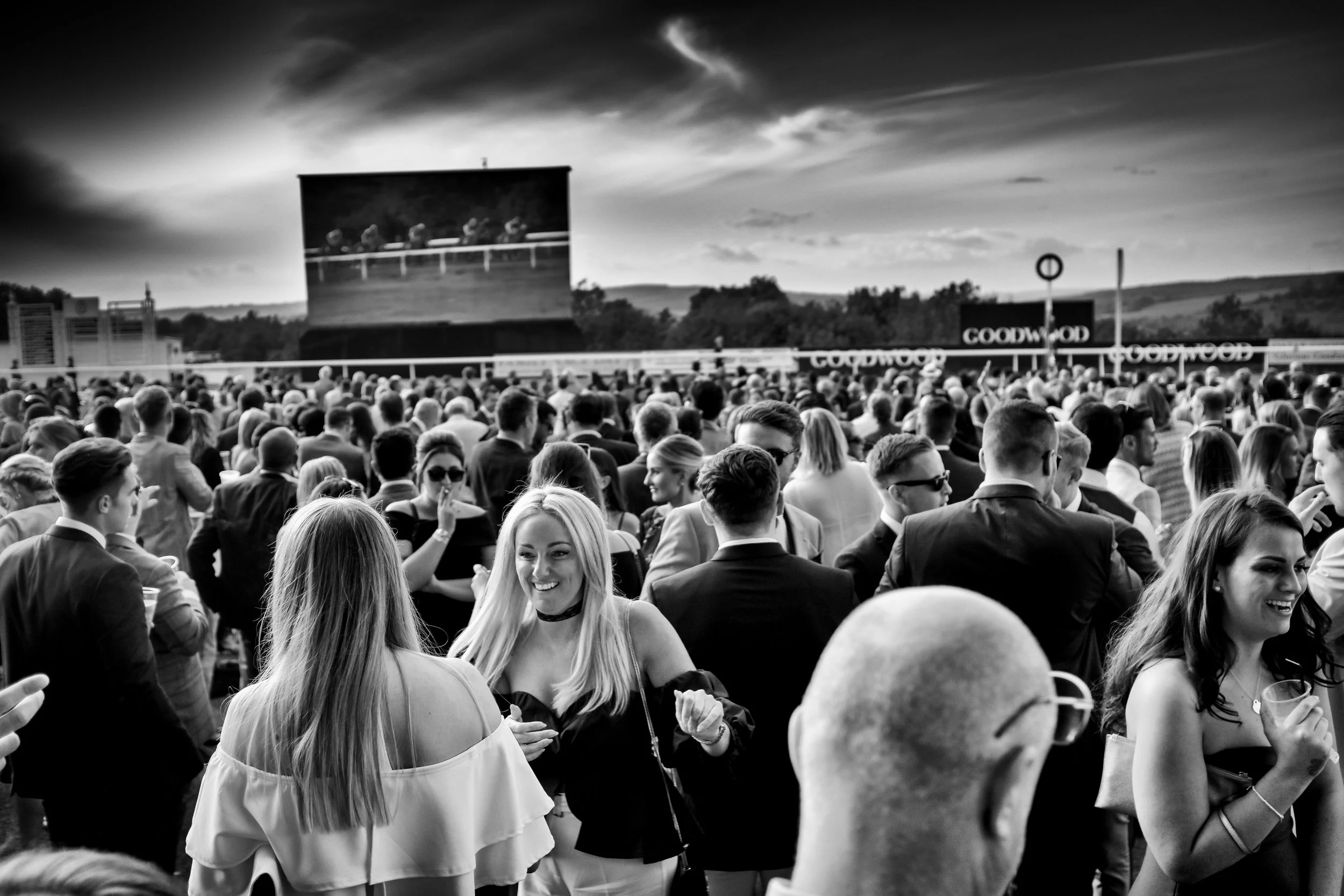
The more photographs I take, the more I am convinced that photographers learn from those greats who have gone before; standing on the shoulders of giants to capture that awesome view or decisive moment - and an occasional indecisive one too. Of course, being in the right place helps.
Last weekend I had the truly great pleasure of being invited to spend the evening on one of the corporate boxes above the finish line at Goodwood races. Even better, this included a car to and from the racecourse; champagne to drown our losses and toast our victories [few]; our own chef; and the perfect reason to leave work about as early as was both feasible and polite as the boss on a Friday night.
Weather wise, it could hardly have been better. The Sussex downs were bathed in a golden light for several hours and stretched for as far as the eye could see and further than my 35mm lens wanted to go.
Between courses there was the opportunity to escape the air-conditioned life of the box and mingle with everyone else by the track. This is where the bookies with their fixed faces line up to relieve you of your notes and replace them with dreams while their expression switches to the next punter in line. This is where overdressed men swelter in the late sun and under-dressed women, fuelled by plastic pints of warm beer or swinging half empty bottles of Moët, stumble precariously on skyscraper heels. It's an oasis for a thirsty street photographer.
Each race brought a new flutter and a five minute amble among these gradually less stable fellow racegoers as their expressions became more jovial [or less so] as their own personal cocktail of winnings, losses and alcohol slashed back and forth.
Most of my shots were taken up close (obeying Robert Capa’s maxim that if your photos aren’t good enough, you aren’t close enough) but I took picture above as it seemed to capture the evening en masse. I particularly liked it because it reminded me of Winston Link's drive in movie shot and it was this classic image that I had in mind when I took it.
https://uk.pinterest.com/pin/97601516906397814/
We truly do learn by looking at the masters and the more we invest in looking at the great photographs the more our own work will grow, I'm convinced of this.
Shoot first. Ask Questions Later. or Better to seek forgiveness than ask permission.
I think the question that I am asked most often is whether I ask permission to photograph people on the street. And if not, how do I get away with it - by which I assume there is surprise that I haven’t been thumped or beaten around the head by my rolled up street map. Or worse.
I don't ask. Fundamentally, I guess the difference is that while the people I shoot would like the world to see them as they would want the world to see them ... I don't. I want the world to see them as they really are. Or as they sometimes are - when they are off guard. This isn't out of some inherent cruelty. It's more a question of truth. After all, isn't that what Art concerns itself with?
The other element in this is that I am not a typical portrait photographer. I wouldn’t know where to begin with posing someone or giving direction. So I have to take what I see.
Finally, I would much prefer to shoot someone caught in what Cartier-Bresson called "the decisive moment." Not some clever, long held pose.
So, I rarely ask permission. There have been rare exceptions. A few months ago, I happened across a Harley-Davidson biker run for charity with all riders dressed as Santa Claus and collections made for local primary schools - something of an interesting shift away from cultural expectations and therefore rich with opportunity. I prowled among the riders with my camera at my hip, finger on the back-button, ready to shoot. And I shot a few. Then I made eye contact; a fatal error. Eye contact with a tall, tattooed, bearded and leather clad ring-leader in his worn waistcoat adorned with his name. Basher.
The omens weren’t good.
So I asked. And he smiled. Posed. And I clicked. It should have been mean, moody and confrontational. Had I had the sense to direct him, I could maybe have got something halfway to what I wanted. And what I wanted was definitely Basher going about his business as, well, a basher. Instead I got the smiling, bearded, Santa imitator - no amount of gritty post-processing would deliver the shot I wanted; the shot I could have got if I’d kept my mouth shut and my eyes down.
Most recently, on a street photography jaunt around London, I noticed two young office workers enjoying early refreshment along the south bank of the River Thames. Nothing unusual about that except that it was extremely cold (being January), they were already gulping down Laurent Perrier champagne, and had clearly been out all night since finishing work the day before. “Make us Facebook famous,” they laughed; I had already shot them from the hip, capturing the wide open champagned arms and flailing cigarette. Would they have chosen beer stained shirts, sleepless eyes and hangover hair for their portrait shoot? I doubt it. Yet somehow, the shot was closer to the truth - for that day at least.
Surely that is the essence of street photography.
Prague
Towards the end of October, I was lucky enough to have a few days visiting Prague and a vast chunk of my time was spent watching the good burghers of the old medieval town going about their daily business. Fair to say it was fairly well packed with tourists too.
Below are a few shots from this beautiful and largely untouched old city.
Cafe Stop. Prague, October 2016.
Luckily turned back at just the right moment to catch this. Love the colours and the fact that she wondered whether I was really taking their picture. Of course I was. How could I not?
Crossing. Prague, October 2016.
Waited some time for this. I was really taken by the huge toy vegetables (I think) on this construction site and wanted a picture with the tiny real people captured below. Timing with the tram was less straightforward.
Drink Club. Prague, October 2016
Just across the Charles Bridge, these locals sat and watched the tourists buzz by. First rule of drink club...
Contemplation. Prague, October 2016.
A snatched opportunity at twilight in Wenceslas Square, saw him but thought I'd missed the opportunity. Love that classic look. And set against the backdrop of the jewellers...
Getting down to work. Prague, October 2016.
One of those chance situations when you know it pays to always carry your camera. Really wouldn't fancy that commute.
Grandmother's Footsteps. Prague, October 2016.
These two seemed to be following their grandmother very carefully and almost discretely - just like the children's playground game.
Foreign Affair
Tom Waits sang "...traveling abroad in the continental style,
It's my belief one must attempt to be discreet,
And subsequently bear in mind your transient position
Allows you a perspective that's unique."
As far as I know, street photography is not something Tom has dabbled in - I'm fairly sure he'd be amazing with his unforgiving eye for detail - though these words could well describe the foreign street photographer's view of a new place. A perspective that's unique. I'm just back from a few days away in Prague - capital of the Czech Republic. For me, it was a first time visit and I have to confess to not only knowing very little about the city but also to not really having done my homework. Tish tish.
A new place is always exciting - for me, with my street photographer hat on (very fetching), it seems to bring fresh impetus and an opportunity to marvel at the everyday things that the locals don't even notice. In Prague it was cobbles and trams, street signs and narrow lanes (especially in the wet), and the beauty of being in a city at night (happens all too rarely for this country based boy).
This time I found that it took me a goodly while to get my eye in - something I hadn't expected. The centre (we were staying in the centuries old New Town - not the Old Town) is remarkably untouched by war and unscathed by business. It's small too, making it easy to visit the key sites in a few days break. All lovely. I don't know whether it was the lack of concrete, steel and reflective glass or the abundance of cobbles, stone and age blackened statues that somehow switched off my street photography goggles. Perhaps it just takes time to adjust to a new place.
My first piece of real street shooting was the photo above - Taking the Strain. I suppose it shows that wherever you go some things remain the same - the sanctity of the worker's playtime, tea break or sneaky gasper - while others take the strain.
Shooting Superman
I've thought long and hard about photographing others less fortunate than myself when I'm out on the streets with my camera; more specifically, those sleeping rough. I remember watching a frail old lady leaning into a wheelie bin in Oxford some years ago, looking for a bite to eat, and my camera twitching in my hands. Here was the wealth of the university town with the offspring of the elite and their discarded champagne bottles from the night before. And here too, someone who had no worldly possessions who had spent the night in a doorway only yards from them.
It was a perfect juxtaposition. I didn't take the photo.
It didn't seem right.
Why?
Maybe it was because she was clearly someone who had fallen on hard times. I could only guess at the circumstances and the details of her story. Here was someone who had fallen so far that she had sunk to doing very basic things in public - sleeping, finding food... Was it right for me to photograph that and then presumably publish it if I deemed it a good enough capture? An enticing composition with a good tonal range.
Or maybe it was because I was very aware that the piece of kit in my hand could have paid for a night or three in a hotel for this unfortunate person. And there are many more valuable cameras available that would pay for many more nights than the one I was wielding.
I'm glad I didn't take the photograph - though her image stays with me. However, I have undergone something of a rethink. Greater photographers than I will ever be have captured now famous images of Victorian or third world street children, of beggars and drifters in every corner of the globe. Time lends them a completely different aspect. Their faces stare back at us from the past with a very livid look in their eyes that paintings could never mimic. Perhaps we lookand pride ourselves that society has moved on from these shoeless ghosts. It hasn't. They will, perhaps, always be with us.
Surely, to walk by and not photograph is to deny their existence. We may not like the fact that we live in a society that allows people to live this way but surely that doesn't mean they should be ignored or photoshopped out of history - if there's even an image to edit in the first place.
When I passed a man sleeping rough, off Charing Cross Road in London in August, he was dressed as Superman. His belongings were beside him and he clearly chose to wear the superhero outfit to draw attention to himself. I hope it brought him a few extra donations. Knowing he was dressing for his audience somehow legitimised my taking his picture. And I clicked as I passed by.
His image is a reminder to me of those less fortunate. Perhaps it will speak out over time as similar images have done for the past one hundred years.
Kissing for Posterity
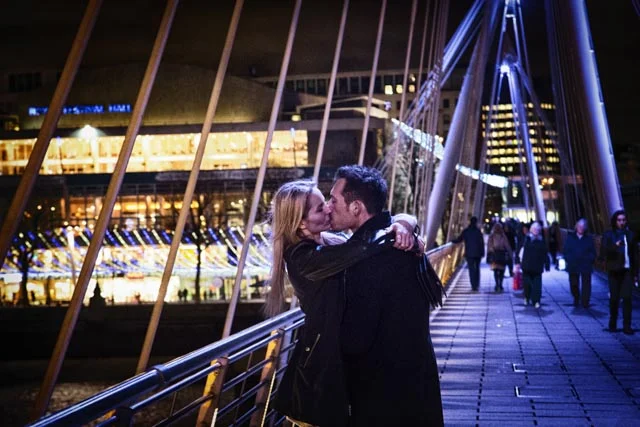
A couple of years ago when I was really just starting out in street photography I took a late night picture of a couple kissing on Hungerford Bridge, London against the backdrop of the Royal Festival Hall. Possibly a good-night kiss. Maybe the promise of something more. We are left to make our own stories. They didn’t know me. I didn’t know them. They didn’t know I was there. I suspect they didn’t know anyone was there, though the bridge was bustling.
I still like the picture. I like the light. Of course, what is missing is any sense of historic occasion.
Last week we learned of the death of Greta Friedman. Despite her name being almost unknown, Greta's image has become one of the defining photographs of the Second World War for she was the woman in white being kissed by a sailor in Times Square as the end of the war in Japan was announced. Eisenstaedt's photo became one of the half dozen or so pictures that will always be associated with the conflict - Capa's Omaha Beach shots; Joe Rosenthal’s GI's hoisting the Stars and Stripes over Iwo Jima; St Paul's cathedral standing proud amidst the smoke and flame of the Blitz in December 1940...
I had always believed that the white uniform was that of a nurse who would soon be free to pursue her normal peacetime calling rather than tending the wounded of the war. However, it turns out Greta was a dental nurse on her break when she came across the sailor in Time Square. The sailor, called Mendoza, had apparently been kissing random women in Times Square as he celebrated the end of hostilities. Try doing that these days.
The presence of a great photographer to capture the moment the sailor met the woman in a white dress sealed both Mendosa and Friedman in time for posterity.
Fifteen years on from 9/11 many of the major photography players have been using their Instagram feeds to bring us images of the day. The images bring us the immediacy and horror in a way that only a photograph can - a moment captured and frozen, pored over and analysed at will by whoever wants to see it.
Part of the power in these images is the technical beauty of the photograph, shot by a master photographer; a beauty which is in sharp contrast to the horror of the unfolding disaster. It's that juxtaposition that creates such impact. Of course, the impact is heightened when it is somewhere that we associate with high tech, comfortable, first world living - like New York. Would the impact be the same with an image of smoke and debris in Aleppo, or anywhere else without a Starbucks, MacDonalds or Nike outlet, I wonder.
It strikes me that it is the very ordinariness of the people in the images that brings the whole story to life. Alex Webb's shot of the woman and her baby on their rooftop against the backdrop of the burning towers and Eisenstaedt's image of Friedman in Mendosa's embrace both bring the disaster down to a personal level involving people with whom we can readily empathise. It is this capacity to hint at our own individual narratives that makes street photography so compelling.
Great Friedman was 92 when she passed away. Beyond that moment, 71 years ago, the world knows little of her life.
Starting out - why now?
When I do things I do them with a passion. Pretty much an obsession. And this is where photography is with me right now. A camera has never been far from my hand over the past three years and it has taught me to see things very differently; definitely to appreciate things more. I even notice what's around me these days.
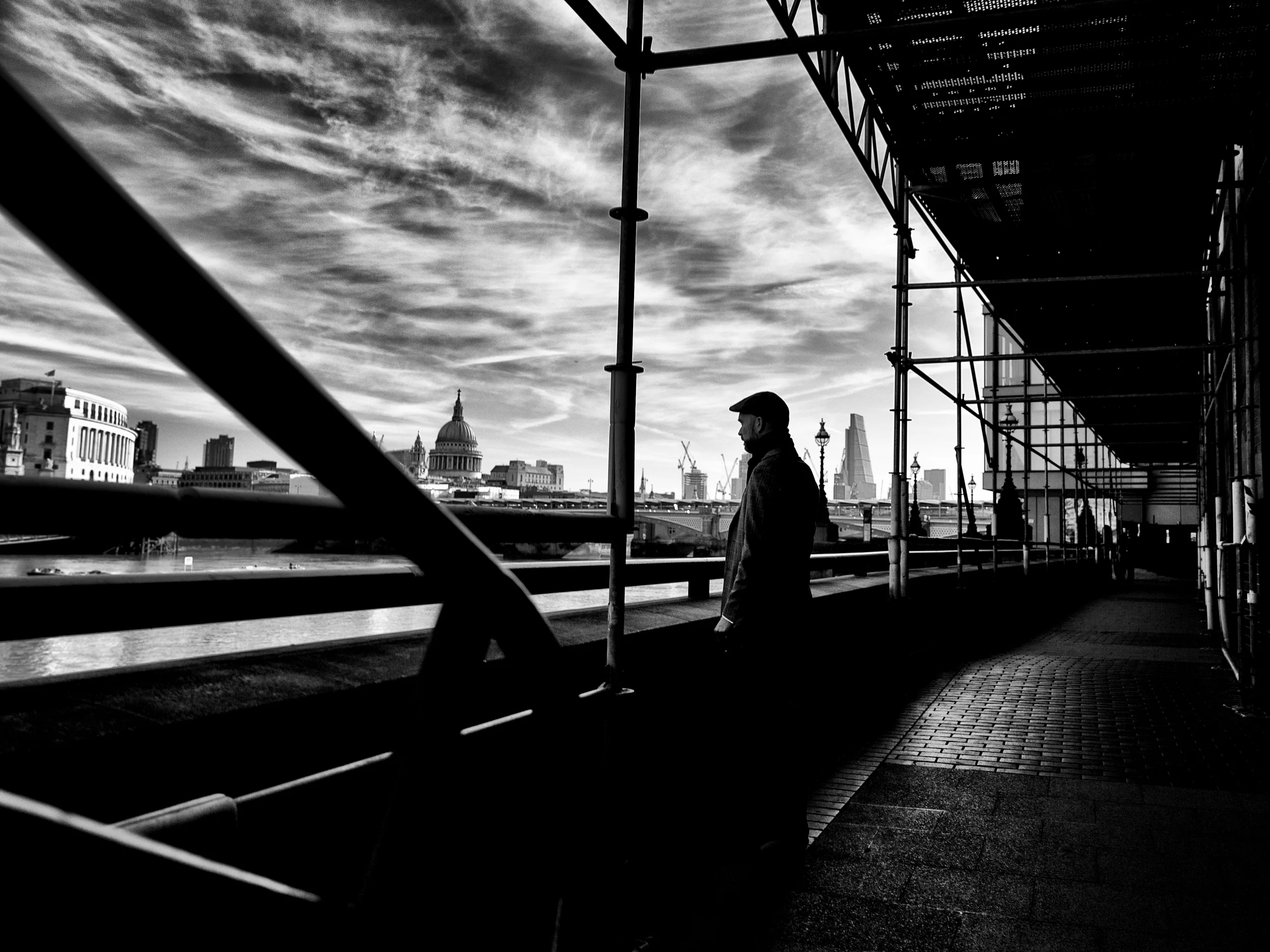
In April, I took a photograph of a man, wrapped warmly against the cold spring morning, standing on the south bank of the River Thames, looking across the water towards St Paul's Cathedral. I went on to take many other photos that morning, wandering the streets of the city as they began to fill, before heading home for lunch. A great way to spend a Sunday. I was already pleased with this one, along with half a dozen others that day.
