

Why do you take photographs?

I know what you’re up to…
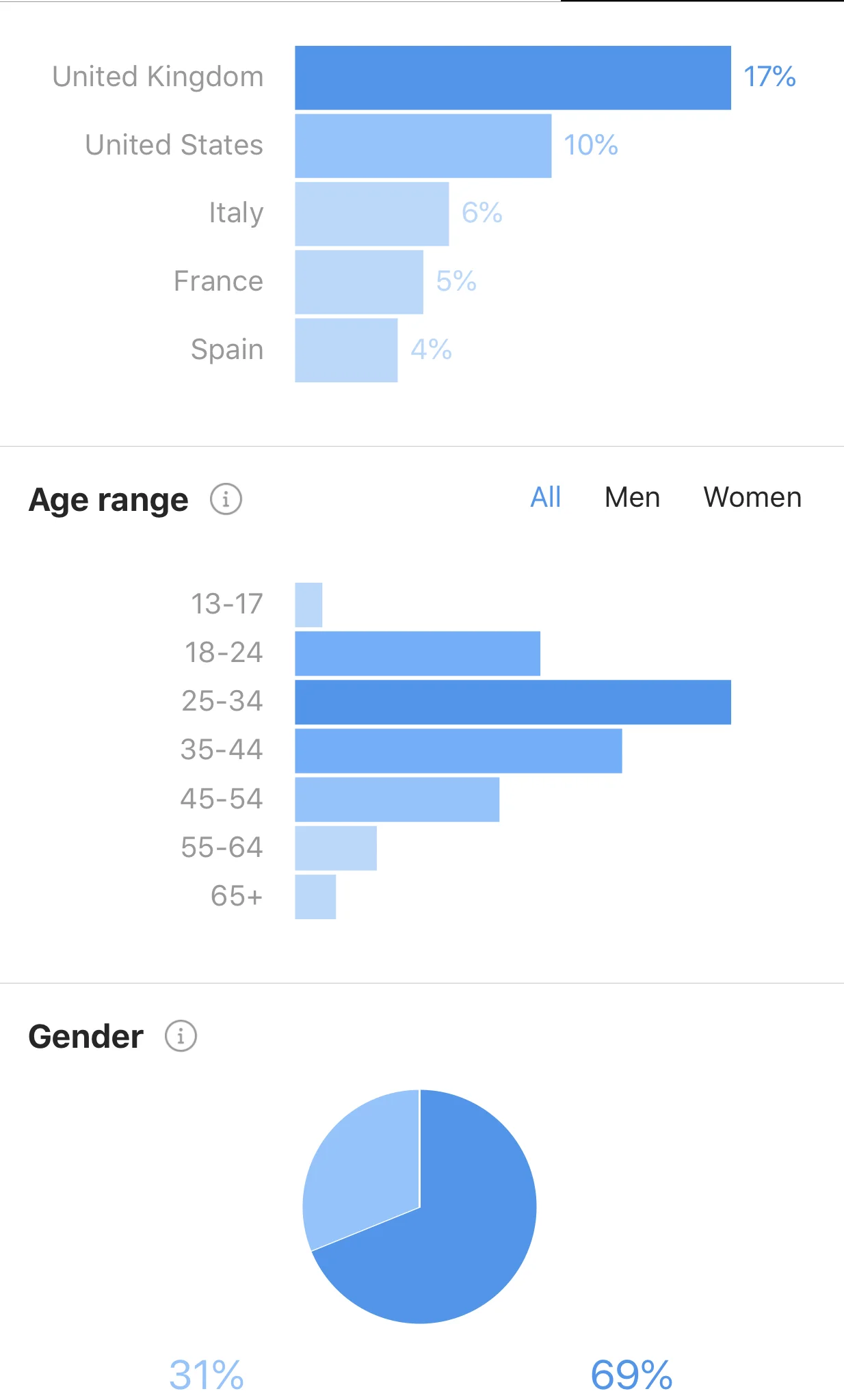
In a recent post (What are you trying to achieve?), I wrote about some of the reasons I take photographs. In my Instagram (@hueyraw) stories I had also asked why you take photographs and this post captures your responses and builds on my thoughts.
As I expected, the therapeutic nature of taking photographs for pleasure registered highly. For most people, in this age of photographic democratisation, with almost everyone having a camera via their phone, photography is not a means of making money and is secondary to the day job. Many of you, like @sleepingastronaut, see it as away to relax; something that takes your mind off work (@mybeardandmypenguin, @chris_silk_street). It’s an escape – something which should not be underestimated in this busy world. As @zenostr33t, puts it “…ultimately it comes down to escaping work day pace.”
““It’s therapy for me; when I go out to take photos all of the other things in my life vanish for a short time.” ”
That therapeutic effect is reason enough to get out and make photos. For some of you, it is clearly more than that. Fabienne (@fabiennehanotaux) recognised “…a deep need to create, to express myself, to escape.”
I think this need to create is deeply human. Furthermore, the artistic element of creation which enables us to express ourselves, our emotions and our feelings in response to the world around us, is enjoyable, communicative and, therefore, sociable. This is underlined by the huge success of social media, such as Instagram, where photographers can now share their work, and enjoy the work of others instantly, and like never before.
This creative process changes us. I know that since I have been taking photos I have become far more alert to my surroundings, spotting things I would never have noticed previously. This is enriching. As @atelier_dope puts it, the “… process of creation is enjoyable and every now and then I’m rewarded with an image I enjoy.”
Many of you commented on how this enables you to see things in a new way and to seek to make the mundane beautiful (@sixframestreet; @piyush_mishtra_18; @theweijian). That is certainly at the heart of street photography and involves self-expression. No one photographer sees a photographic opportunity in exactly the same way as the photographer standing beside them. The slight difference in viewpoint is one thing, but the personal experiences that each of us as individuals bring to bear, our likes, dislikes and individual taste, all impact upon the final image created.
Perhaps the more scientific among us only seek to record daily life, something more like an objective view of a crime scene or scientific evidence. The camera has a unique ability to take a slice of life, a fraction of a second, and freeze it forever to be scrutinised and analysed for as long as the image exists. @frances_pegg wrote about catching a personal moment in order to “taste it when I get old.”
Recording daily life for oneself is the personal version of storytelling, which is usually more about the lives of others. For some of you, it was this that was your motivation. @mrtimothypeter put it simply when he explained “I love telling interesting stories.” As humans, most of us find other people fascinating to a greater or lesser extent. I have always enjoyed looking back at photographs of places I know and seeing how they have changed but this experience is far better when there are people in the shot. If we recognise them it is heightened because we can see how time has changed them. If we don’t, then we can also pick up on the visual clues in the changes of fashion, of the street furniture, shops, styles of cars (or lack of) and so on. @sixframestreet speaks of documenting the human experience and this is an important element of street photography which is not necessarily about aesthetics and creating something of beauty but is about building a record which will inform the future. Many pictures improve with age – an ordinary scene today will take on many other qualities in years to come. If you don’t believe me, think about a typical High Street today with a huge number of people lost in mobile phone land. Will those phones still exist in half a century? If they do, will they really look like they look today? What about the clothes? And for the acid test, find a photo of an everyday, ordinary street scene from 1969 and see how nostalgic it feels.
Some of you recognised something powerful about the actual process of making photographs. Specifically thinking about street photography, @ashsmithone cited “…the thrill of the chase.” And I totally get that. The adrenalin rush of going out to shoot and not knowing what you will get, what lies around the next corner and what may happen next is exhilarating – if not for everyone. It is a thrill and there is a fear to it; fear of being caught, fear of not getting the shot even. That brings adrenalin.
The thrill, the adrenalin and even the fear very quickly lead to what @gianpy_s described when he said “It’s a passion.” That is certainly something many of us would agree with. Why else would we spend hours walking our shoes down to nothing, only to come back with a small handful of decent shots - if we’re lucky?
A passion can become a necessity and for @mark_lev-photo it seems to be a compulsion: “I don’t know why! I just feel compelled to do it.” Whereas @ke_vin_joseph says “The voice in my head tells me to.” For @mandym.photos it is “Just something I can never switch off from – which is mostly a joyful thing.”
Whether it is something you have to do to balance up your life with the part of you that is work; whether it’s something you just need to feel complete creatively; whether it’s a voice in your head making you do it; photography clearly plays an important part in making each of you “you”. That has to be a good thing. I certainly feel that it completes me. And there are far worse things you could be doing in your spare time.
I leave the final comments to @oohbaaanana who says: “It’s the only thing I think about all day and it’s the only thing in life in which I’m really free.”
Amen.
A huge thanks to everyone who shared their thoughts with me but especially to these good people who you should check out on Instagram:
@zenostr33t
@sleepingastronaut
@mybeardandmypenguin
@chris_silk_street
@billtakesphotos
@fabiennehanotaux
@atelier_dope
@sixframestreet
@piyush_mishtra_18
@theweijian
@frances_pegg
@mrtimothypeter
@ashsmithone
@gianpy_s
@mark_lev_photo
@ke_vin_joseph
@mandym.photos
@oohbaaanana

Best of April 2019
Sixteen from the streets of London and Venice. Feel free to comment.
Click to go LARGE.


What are you trying to achieve?
Venetian Stretch.
Venice, Italy. Apr 2019.
This is the question that was asked of me some months ago and that keeps coming back to re-play in my head. It’s not so much that it bothers me - I don’t take photos for a living or even make money from my photography. It’s more that it surprised me. It forced me to look at what I do from the perspective of those who know me best.
I’ve always been a passionate person and my interests (obsessions) have led me down many alleys, nooks and crannies of exploration. For the past few years, photography has been my boulevard of choice (and, yes, sometimes dreams). When an interest takes me like this, I want to know as much as I can about it. I immerse myself in its history, its culture, its traditions - I want to know what it feels like, to taste it, to live it. Books, galleries, the internet … anything can support my habit. Taking photos and editing them is drinking from the source.
I suppose that is what I have been doing. So, while friends and peers are of an age where they are having a quiet morning with the cafetière, hot buttered toast and the Sunday papers, I will be catching the early train to the big city hoping to return a few hours later with a camera full of more images than you can shake a selfie-stick at before I get a chance to go and do the same thing again.
Too old for this kind of thing?
So, okay, fair enough. What am I trying to achieve?
It does have a slight ring of "Aren’t you a bit old for this kind of thing?” and it is true that most street photographers who I follow (and who follow me) on instagram are 20 years (gulp - two decades) younger than me. Not that that should bother me - there are no age restrictions to developing a good eye or understanding the exposure triangle, or indeed breaking any of the rules that aren’t actually rules and that need breaking anyway (ahem). I digress. Maybe it’s more that most of my peers don’t feel the passion that I feel or the excitement for learning new skills, seeing things in new ways and, most importantly, having a chance to be creative.
That is what is at the heart of it for me. Being creative. I have realised over the course of my life, that the creative urge is more of a creative need in me. I need to feel creative to feel complete - to be me.
Mindfulness
There’s a great deal of talk about mindfulness and mental health these days. For me, I know that the creative process is key to my mental health. It is where I go to be mindful. It just so happens that it is street photography that provides that creative process.
Passion is an important idea here. Shooting street does bring out a passion in me. That doesn’t mean it always is easy or always pleasurable. Remember passion, as a word, has its root in the Latin for “suffering.” So if we are passionate about something, we are putting more into it than is absolutely necessary. How many times have you spent a day shooting only to feel that what you’ve shot is rubbish and all you have to show for it is a thinner sole on your trainers?
What am I trying to achieve? I do it because I have to.
It feeds me.
It completes me.
How about you? Some weeks ago I asked my instagram followers this question and I will be sharing further thoughts soon. If you’d like to comment, please feel free. I look forward to hearing from you.
Best of March 2019
Sixteen from London’s streets from March. Let me know your thoughts below.
Click on the image to go LARGE.


They shoot children... don't they?
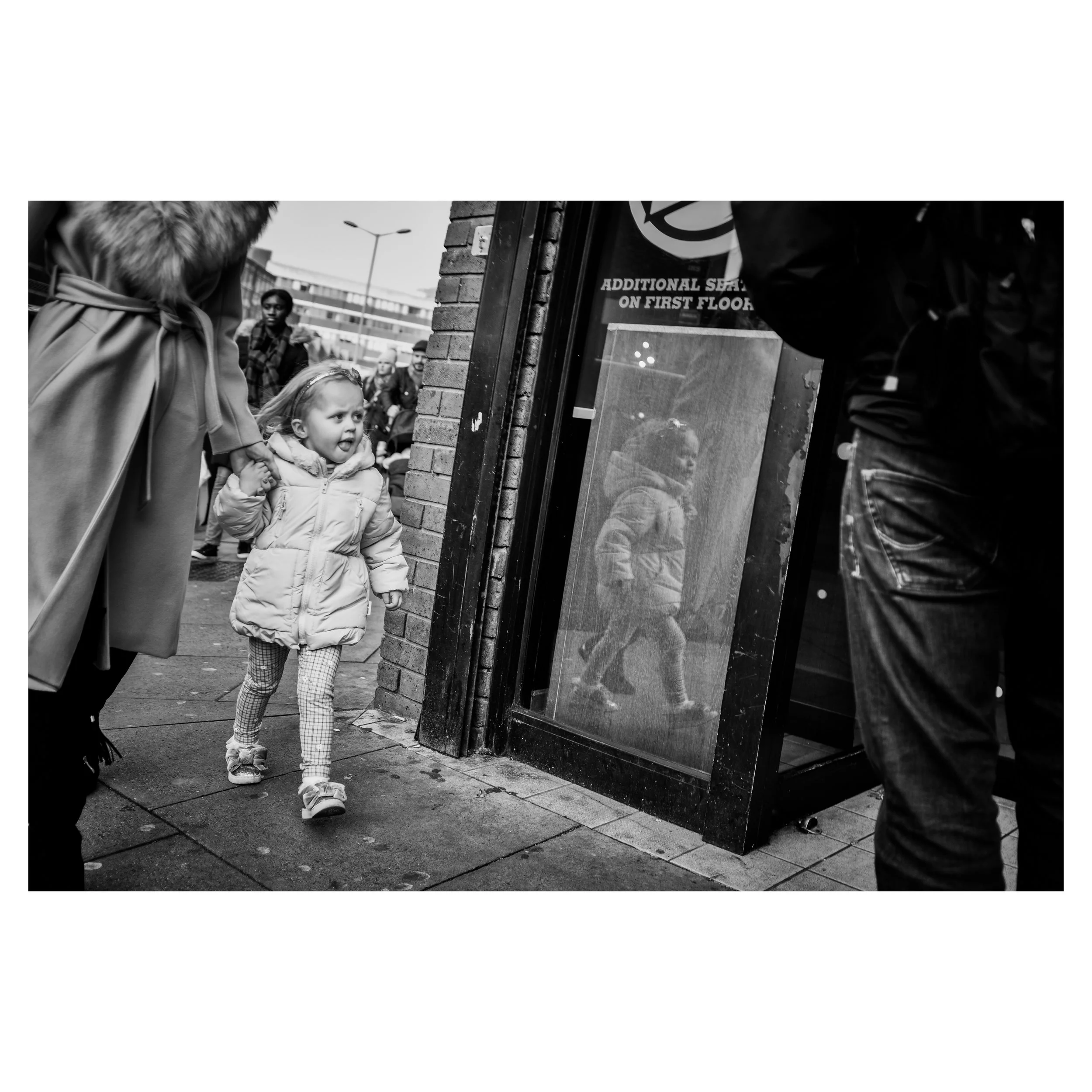
Twin.
The history of street photography is full of images of lively children - shoeless and happy playing in derelict city streets, smiling in an outsized pair of mothers shoes, carrying home the shopping or, as in Henri-Cartier Bresson’s famous shot, a bottle of red under each arm and a cheeky grin.
Look through the average street photography account on Instagram, or any other social media stream, you will be hard pushed to find the younger generation at all. Sadly, this is not surprising.
We all know why. Nobody wants to incur the wrath or worse, the stream of abuse, of an irate parent fearful that their child’s image has been stolen for all the wrong reasons. And, therefore, many of us don’t try. Those images of children not only never appear - they are never taken. A hidden generation is being created at a time when we take more photos than ever.
Yet, if you walk into any town centre, children from decades ago, now adults or well-beyond, stare out from the ranks of birthday cards in stationers and supermarkets. Pick up a book of street photography from the last century, there they are; captured for posterity like ancient insects in amber. It’s almost as though children and their beaming smiles belong to another age and the streets today are devoid of children. Anyone remember the child catcher in Chiity Chitty Bang Bang and the empty square around the castle?
Are we to become the generation that didn’t have children? Or, at least, that airbrushed or Photoshopped them out of history? We would be much poorer for it - but that’s the risk.
Of course it is about intent. Why is the photographer taking the photograph in the first place? What is it they want to show? It is this intent which raises photography beyond a simple and precise record of a scene or object - almost for classification purposes. It isn't simply a scientific practice concerned with obtaining a correct exposure through combinations of shutter speed, size of aperture and sensitivity of sensors or film. It is an art form in which the photographer expresses an emotion, idea or even just a viewpoint. Surely any photographer who takes a photograph of a child for the wrong reason or with ill intent, will produce work which sets alarm bells ringing or, at the very least, leaves a bad taste in the mouth of the viewer.
Children’s lives hugely enrich our own. They remind us of a distant past that we often hanker after. They point to a future full of potential. They provide moments of great humour - often through their attempts to be more like us, the grown ups. They possess a wide eyed sense of wonder that reminds us just how amazing our world is at times when we have grown weary of it ourselves. And photographs of children can do all of these things too. They often point to a truth that, as adults, we need reminding of.
Of course, the problem of the disgruntled and anxious parent doesn’t go away. However, we will only perpetuate the situation if we accept it. We can challenge it by taking good photos of children. If we are open and upfront about what we do then maybe the disgruntled mum or dad would recognise the same things in the image that we saw. We should be less inclined to be furtive, secretive and hidden but be prepared to share positive ‘good’ images of children on our feed. That way we can demonstrate our good intent next time we meet an anxious mum or dad. And, as with any street photograph, smile, share your Instagram or website details and offer to email them a copy. All parents think their children are the best thing since bread arrived sliced - hey; they might even ask you to take some more.
Perfection Postponed

I’m writing this for myself, as much as for anyone else. I need to remind myself that sometimes I just have to get on with it. Stop putting it off and just do it, to coin Nike’s phrase.
No more waiting until everything is in place. Because it never is.
Let’s face it, we will never ever feel that something is completely ready, never feel that it’s good enough, never feel that we have said it, photographed it, processed it... in the best possible way.
So get on with it. Print your work. Make a book. Host an exhibition. Launch your website. Photograph strangers. Whatever it is…do it. Unless we actually begin, we will never finish. And, do you know what? Sometimes, when we begin, we realise that the finishing part isn’t quite so hard.
Last time I said "We are all seeking the ultimate photograph. That one shot that says it all!” That wasn’t meant as a reason to give up because we will never be satisfied. It was meant as a recognition that it is that very act of striving that makes the likelihood of achieving it more likely. As Elliot Erwhitt said "Nothing happens when you sit at home."
So what is the ultimate photograph? We assume that every great photo we see is perfection itself, don’t we? Just because it’s in a book, or on a gallery wall or on Instagram. But every artist, great or small, from Sebastian Salgado to the girl next door with her selfie stick, must surely feel as we all do. That they could have done it better if…and you can finish that sentence yourself with one of over a million different reasons.
Think of your best photo. The one that you are most proud of. If you have a website, it’s that one there, right on the Home page. If you could show me - I guarantee you would also point out where it could be improved. If the light had been better; if you’d got there later, stayed there longer; if you hadn’t over saturated the processing… We all do it.
It is human nature to compare ourselves and our achievements with others. And to put ourselves down. It stems from a primeval need to survive, from a time when we humans were always on the look out for threats. But there are no sabre toothed tigers on Instagram.
We are all constantly striving for artistic perfection and never feel that we achieve it. And, do you know what? That’s fine. It’s the striving and envisioning that is important. That is how we hone our craft. By taking the shot, putting out there and gauging the response. Not by sitting back and waiting for the perfect moment.