


Post Lockdown London - The New Normal
As London began to reopen in early July, I photographed the deserted streets.

I always remember seeing photographs from the Second World War showing streets with people rushing to sand bagged air raid shelters, or newspaper boys with hoardings proclaiming the outbreak of war, or crowds dancing jubilant in Trafalgar Square on VE Day. There was something mesmeric, possibly haunting, abut the familiarity but strangeness of these images. Here were places I knew, and scenes that were familiar, but distorted by the events that had transformed them at that point in time.
History has always fascinated me and part of it has been a desire to be able to go back and witness momentous events but to be able to do it safely. I think that would be my superpower, if I could choose one. And of course, I’d have a camera in hand.

I have always counted myself lucky that I grew up in a generation that never experienced the world wide conflicts that took place in the first half of the last century. These were events which in many ways defined the age and the generations that lived through them. Now, this global Corona Virus pandemic has provided our defining worldwide event.
The invention of the camera, less than two hundred years ago, gave to history the means to record more objectively and instantly than ever before. As street photographers, I truly believe that it is our responsibility to record our current times for those still to come, just as Bert Hardy, Bill Brandt and Alfred Eisenstaedt did for World War Two with their images of GIs, tube sheltering Blitzed Londoners or sandbagged Whitehall. I have always felt that the ubiquitous appearance of mobile phones, ear pods and vapes would be the accoutrements that would characterise our times when people looked back.
Then along came Covid-19.
Who could have predicted that summer 2020 would be defined by empty streets, face masks and huge government publicity campaigns? In actual fact, very much like World War Two.
So, I was keen to capture these street scenes. But not keen, also.

I wouldn’t be walking the streets of London with one eye skyward for a doodle bug, Stuka or V2 rocket. I wouldn’t get a siren warning of impending danger. My enemy was the Covid-19 virus - invisible, undetectable and potentially anywhere. After months of taking great care and working from home whenever possible, as the government advised, travelling on public transport and being out and about in London felt like a risk I possibly shouldn’t be taking. After all, I was only going to take photos. Who did I think I was? David Bailey?
But there was also a longing to return to normality and a desire to experience the creative process of making a photograph: that moment when everything else ceases to exist or, at least, to matter. Let’s face it. I needed to get back to street photography to recapture a sense of self, of what makes me me; if nothing else.
Two good reasons then - a responsibility to posterity and my own mental well being!

And so it was I found myself exiting an almost deserted Sunday morning train at London Waterloo, glasses steamed up from the mask that I was not yet used to wearing, camera clutched in my sweating right hand, phone gripped with my online ticket ready to scan at the gates.
Waterloo itself was immediately different with just a small number of people on the concourse. I wanted to capture the gates with all of the 2m distancing signage and encouragement to wash hands but was immediately pounced upon by three transport officials who wanted to know what I was doing. I suppose it’s not technically a public space so they were presumably within their rights to challenge me. I explained that I was a street photographer and they looked at each other and shrugged - seemingly proof enough of my credentials. I wasn’t quite so lucky a few moments later when another officious, uniformed woman told me I would need a permit to take photographs at Waterloo. Having shot there unchallenged many times, it did feel like a wartime restriction.

Moved along, the streets were deserted. I know it was a Sunday but it was a shock to see the streets around the station with no one on them. I crossed over Hungerford Bridge to Charing Cross. There seemed to be the lowest tide I had ever witnessed on the Thames (Sunday 5th July) which only served to make what should have been a glorious summer Sunday seem even more surreal. It was as if the people and old Father Thames were deserting the city.

In Trafalgar Square, Nelson gazed down on acres of stone, concrete and pigeons. There were the classic London red buses, making their rounds almost empty, but not a soul in the square.

The same was true of Piccadilly Circus - just a solitary figure at a hand sanitising kiosk, offering a squirt to anyone who happened to walk by. Hardly anyone did.
Regent Street was pretty much the same. Oxford Street only slightly busier, a handful of curious wanderers, but nothing like the usual melee of tourists, office workers and rough sleepers.
This was the day after the Boris Johnson’s government had allowed the pubs, bars and restaurants to reopen after weeks of lockdown. Soho had apparently been heaving with little acknowledgement of social distancing, as revellers enjoyed the cork fizzing out of the bottle of pent up frustrations. The following morning was quiet. Perhaps a hangover. But there was almost no one in good old London town.

Masks, NHS rainbows and thank yous, hand sanitising stations, closed signs on restaurants, familiar buses but fewer and empty, tube exits closed, pedestrians redirected... the first signs of normality.

Arriving home, I shared my images with intrigued friends and families, eager to see what had become of the capital city, just not quite ready to visit it themselves. And the the doubts crept in. Should I have gone? Had I caught anything? Would I be infecting anyone?
And the wait to know I was fine began.
Why do you take photographs?

I know what you’re up to…
In a recent post (What are you trying to achieve?), I wrote about some of the reasons I take photographs. In my Instagram (@hueyraw) stories I had also asked why you take photographs and this post captures your responses and builds on my thoughts.
As I expected, the therapeutic nature of taking photographs for pleasure registered highly. For most people, in this age of photographic democratisation, with almost everyone having a camera via their phone, photography is not a means of making money and is secondary to the day job. Many of you, like @sleepingastronaut, see it as away to relax; something that takes your mind off work (@mybeardandmypenguin, @chris_silk_street). It’s an escape – something which should not be underestimated in this busy world. As @zenostr33t, puts it “…ultimately it comes down to escaping work day pace.”
““It’s therapy for me; when I go out to take photos all of the other things in my life vanish for a short time.” ”
That therapeutic effect is reason enough to get out and make photos. For some of you, it is clearly more than that. Fabienne (@fabiennehanotaux) recognised “…a deep need to create, to express myself, to escape.”
I think this need to create is deeply human. Furthermore, the artistic element of creation which enables us to express ourselves, our emotions and our feelings in response to the world around us, is enjoyable, communicative and, therefore, sociable. This is underlined by the huge success of social media, such as Instagram, where photographers can now share their work, and enjoy the work of others instantly, and like never before.
This creative process changes us. I know that since I have been taking photos I have become far more alert to my surroundings, spotting things I would never have noticed previously. This is enriching. As @atelier_dope puts it, the “… process of creation is enjoyable and every now and then I’m rewarded with an image I enjoy.”
Many of you commented on how this enables you to see things in a new way and to seek to make the mundane beautiful (@sixframestreet; @piyush_mishtra_18; @theweijian). That is certainly at the heart of street photography and involves self-expression. No one photographer sees a photographic opportunity in exactly the same way as the photographer standing beside them. The slight difference in viewpoint is one thing, but the personal experiences that each of us as individuals bring to bear, our likes, dislikes and individual taste, all impact upon the final image created.
Perhaps the more scientific among us only seek to record daily life, something more like an objective view of a crime scene or scientific evidence. The camera has a unique ability to take a slice of life, a fraction of a second, and freeze it forever to be scrutinised and analysed for as long as the image exists. @frances_pegg wrote about catching a personal moment in order to “taste it when I get old.”
Recording daily life for oneself is the personal version of storytelling, which is usually more about the lives of others. For some of you, it was this that was your motivation. @mrtimothypeter put it simply when he explained “I love telling interesting stories.” As humans, most of us find other people fascinating to a greater or lesser extent. I have always enjoyed looking back at photographs of places I know and seeing how they have changed but this experience is far better when there are people in the shot. If we recognise them it is heightened because we can see how time has changed them. If we don’t, then we can also pick up on the visual clues in the changes of fashion, of the street furniture, shops, styles of cars (or lack of) and so on. @sixframestreet speaks of documenting the human experience and this is an important element of street photography which is not necessarily about aesthetics and creating something of beauty but is about building a record which will inform the future. Many pictures improve with age – an ordinary scene today will take on many other qualities in years to come. If you don’t believe me, think about a typical High Street today with a huge number of people lost in mobile phone land. Will those phones still exist in half a century? If they do, will they really look like they look today? What about the clothes? And for the acid test, find a photo of an everyday, ordinary street scene from 1969 and see how nostalgic it feels.
Some of you recognised something powerful about the actual process of making photographs. Specifically thinking about street photography, @ashsmithone cited “…the thrill of the chase.” And I totally get that. The adrenalin rush of going out to shoot and not knowing what you will get, what lies around the next corner and what may happen next is exhilarating – if not for everyone. It is a thrill and there is a fear to it; fear of being caught, fear of not getting the shot even. That brings adrenalin.
The thrill, the adrenalin and even the fear very quickly lead to what @gianpy_s described when he said “It’s a passion.” That is certainly something many of us would agree with. Why else would we spend hours walking our shoes down to nothing, only to come back with a small handful of decent shots - if we’re lucky?
A passion can become a necessity and for @mark_lev-photo it seems to be a compulsion: “I don’t know why! I just feel compelled to do it.” Whereas @ke_vin_joseph says “The voice in my head tells me to.” For @mandym.photos it is “Just something I can never switch off from – which is mostly a joyful thing.”
Whether it is something you have to do to balance up your life with the part of you that is work; whether it’s something you just need to feel complete creatively; whether it’s a voice in your head making you do it; photography clearly plays an important part in making each of you “you”. That has to be a good thing. I certainly feel that it completes me. And there are far worse things you could be doing in your spare time.
I leave the final comments to @oohbaaanana who says: “It’s the only thing I think about all day and it’s the only thing in life in which I’m really free.”
Amen.
A huge thanks to everyone who shared their thoughts with me but especially to these good people who you should check out on Instagram:
@zenostr33t
@sleepingastronaut
@mybeardandmypenguin
@chris_silk_street
@billtakesphotos
@fabiennehanotaux
@atelier_dope
@sixframestreet
@piyush_mishtra_18
@theweijian
@frances_pegg
@mrtimothypeter
@ashsmithone
@gianpy_s
@mark_lev_photo
@ke_vin_joseph
@mandym.photos
@oohbaaanana
Best of March 2019
Sixteen from London’s streets from March. Let me know your thoughts below.
Click on the image to go LARGE.


Best of February 2019
Sixteen from February out and about on the streets of London and Cambridge.
I would love to hear your comments below.
Click on the image to go LARGE.


British Photography Awards
Thrilled to be shortlisted in the Street category of the British Photography Awards with my image All The Fun Of The Fair.

All The Fun Of The Fair
Chiddingfold, Surrey. 2018.
Part of the competition is a public vote and you can vote for my image by clicking on the image which will take you to the link.
Please do look at the other images and categories - there is some amazing talent on show.
Twitter: @GBPhotoAwards
Instagram: @britishphotographyawards
Facebook: @britishphotographyawards
Imitate, Innovate, Invent

Who's the leader?
Hungerford Bridge, London. Sept 2018.
Sometimes it seems that there is an almost constant reassessment and reevaluation of social media. Often the most vocal critics are those who seem unable to walk away from it. Personally, I enjoy the opportunities to learn from others’ work, and to place my own in the public eye for a far wider audience than I could ever have dreamed of. The way I see it, we are all learners, learning all the time - to a greater or lesser extent. Even those with tens of thousands of followers post disappointing images sometimes. And do you know what? They probably never feel completely satisfied with their work either. I bet that occasionally they post photos that they expect to be met with great acclaim, only to find the silent curse of internet tumbleweed blowing through their feed. Just as I do. And at other, less-inspired times, they probably post something that’s been gathering virtual dust in the cellar of their hard drive, only to find it being greeted with wide acclaim and a posse of new followers. Just as I do.
We are all seeking the ultimate photograph. That one shot that says it all!
It’s human nature to want to get better at whatever we are doing. We are also our own harshest critics, pointing out why our latest great hope is actually fatally flawed. We failed to nail it. Name your top three all time greatest photographers and I guarantee that they would tell you that they never nailed it either. Cartier-Bresson, Winogrand, Leiter, that Instagram shooter with a squillion followers… If only we could ask them.
It’s natural to be striving for improvement; for innovation; for that new angle. There’s always something we could do better next time.
Throughout history people have been inspired by others. It’s natural to want to recreate something that has brought us pleasure. That does not mean a direct imitation - plagiarism - but a desire to create something which evokes the same feeling, creates the same atmosphere, has the same message; or any combination of these and more. We learn by imitating. It helps us to understand what the originator did - be it artistic, scientific, sporting - whatever...
Once we have understood how something was done, we can then assimilate that technique into our own skillset. We are in a new position - we are able to innovate. Taking our new skills, we bring our own background, experiences, tastes etc to the creative process and can now shoot a new image. This image is rooted in all we learned from the original artist but we have moved it beyond imitation to create something new. This innovation is all part of finding our “voice” or distinctive style.
We have all experienced knowing who took a particular image before being told, simply by recognising certain elements and features of their style. With perseverance, the best artists find their own distinctive, easily identifiable style. They have learned their craft and have moved beyond imitation and innovation, based upon their initial artist led inspiration, to a higher state where they are able to use their hard earned skills to create something totally new, in their own unique voice. This is invention. Invention needs both imitation and innovation. No one invents in a creative void, out of nowhere.
This is the learning process. It is something everyone goes through - from learning to speak to painting the ceiling of the Sistine Chapel. Pick up a photography magazine and you will read an interview in which professionals tip their hats to those who have gone before. They are happy to acknowledge the influence of a Robert Frank, a Cartier-Bresson, a Garry Winogrand. Or go to a big hitter on Instagram and you’ll find that very often their feed will happily direct you to others who they admire. Even the first photographers (without any photographers to emulate) were influenced by the fine artists of the past, learning composition from the painters and sculptors of the previous thousands of years.
It was partly as a result of a recent tense exchange on social media that I decided to put down these words. The debate centred around the use of public spaces and whether one photographer can claim to own a specific view because they believe they shot there first. The streets are busy places and London (perhaps more than other cities at the present time) is seemingly filled with street photographers. Beyond that, anyone with a smartphone has the capacity to shoot in these popular places. The great views are, after all, popular for the very reason that they are great views. Some places will be there for centuries to come - monuments, grand buildings, landmarks. Others are more transitory than others - advertising hoardings, building sites etc. Perhaps the work of another photographer encourages us to emulate their work in a certain place, or even to feel that we can build on what they achieved, having a go at creating something new for ourselves as we seek to present our own unique take on our surroundings. Once we can imitate what they have created, we can then innovate and finally invent our own unique image. Each of us is a singular and creative individual - each with our own unique outlook, background, likes, dislikes, tastes and way of seeing. We are all striving to develop our own voice or style that incorporates that uniqueness - but we need to learn from those around us and those who went before.
There is room for us all.
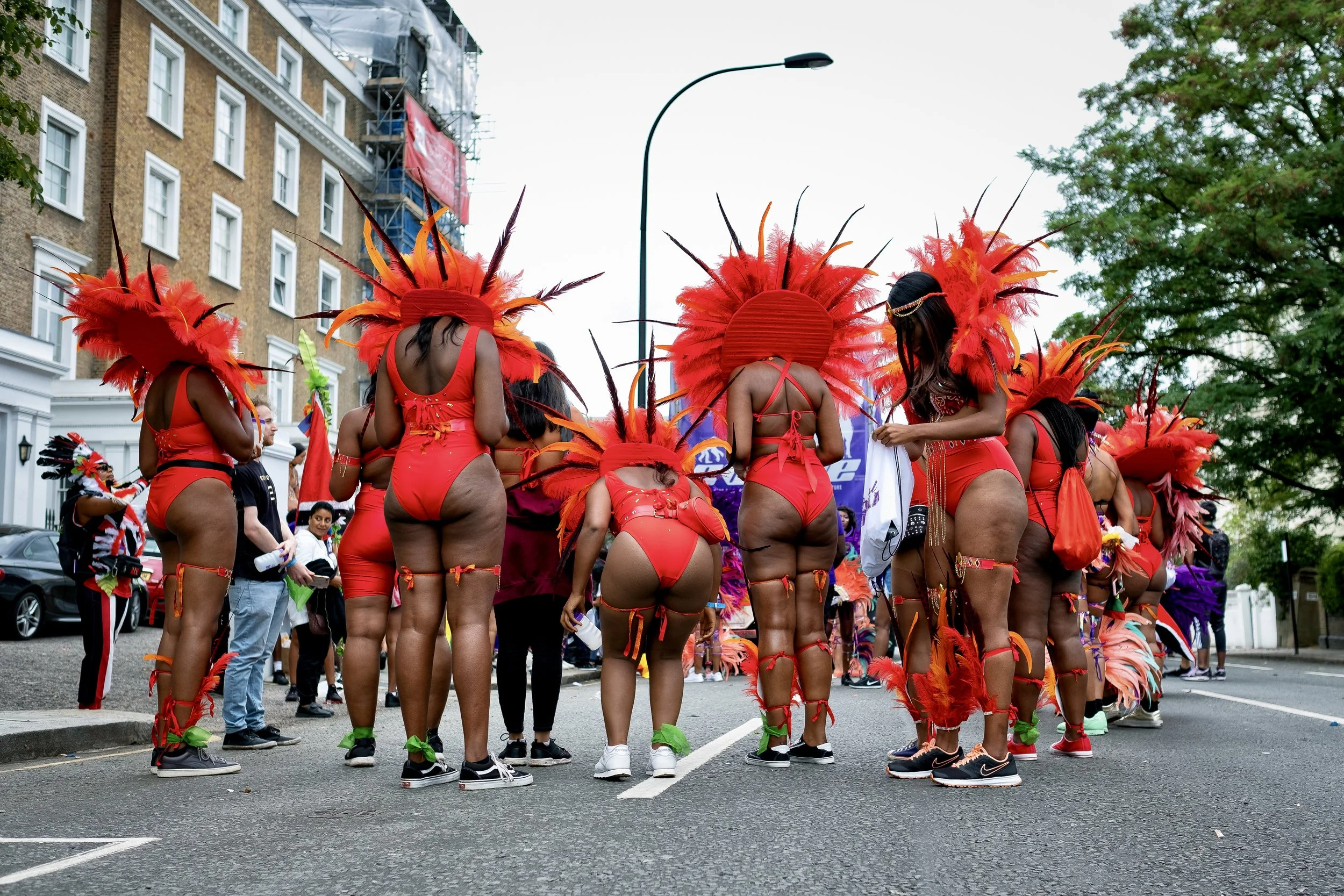
Carnival
Highlights from Notting Hill Carnival 2018.
And so to Notting Hill...
What an amazing event the carnival was. Nothing any camera can do will ever come close to capturing the noise and the atmosphere but the colours and sheer liveliness of carnival was amazing. A true melting pot of all the best that multi-cultural London can offer.
You can check out my images from carnival by clicking the image below:
