

How I See It: Brighton Street Photography In The Summer Sun
I spent one bright summer day wandering through Brighton with my camera — no plan, no route, just seeing what turned up. It was one of those days when everything felt alive: the sea, the light, the movement of people. I wasn’t chasing big moments, just small alignments — those flashes where shape, timing, and human presence come together for an instant and then disappear.
Here are three photographs from that day and some thoughts on what drew me to each.
1. The Rollercoaster – Brighton Pier

Turbo Check. Brighton, England. August 2025.
Fujifim X-T5 56mm f2.8 1/8000sec
What caught my eye first was the structure itself — a looping tangle of yellow and blue steel against a flat, almost cloudless sky. It felt quite architectural, but playful. Then I noticed a lone figure inside one of the loops, working quietly among all that machinery. Suddenly the whole thing shifted from abstract to human.
Composition:
The circular frame of the track became a natural enclosure, drawing the eye straight to the person. I’m always intrigued by how the eye is drawn to a human figure in an image - no matter how small.
I liked how the curved forms countered the rigid geometry of the supporting beams, giving the image movement even though nothing was actually moving. The scale works too — the figure is small enough to make the structure feel monumental, but still strong enough to hold attention. I framed it so the sky could breathe around it, letting the colours and shapes do most of the work.
Story:
There’s something slightly ironic about it — a ride built for speed and excitement, and a single worker making it function, unnoticed. It’s not a dramatic scene, but it says something about human presence in constructed spaces — how we keep these systems running quietly behind the spectacle.
Timing & Light:
The afternoon light was bright and crisp, the kind that makes colour sing but still leaves enough shadow to give form. The palette — lemon yellow, sky blue, and the flash of orange on the worker’s clothes — gives it that summery, almost graphic feel.
Overall Impression:
I like the balance between humour and order here — a bit of geometry, a bit of absurdity, and a human thread tying it all together. It’s simple, but it speaks to the idea of finding structure and story in everyday scenes.
2. The Wave and the Pier

Brighton Splash. Brighton, England. August 2025.
Fujifilm X-T5 56mm f4 1/2000sec
This frame came together in seconds. I’d been watching the sea hit the wall below the promenade, with the skeletal West Pier in the distance. Then a wave hit just as a few people were standing along the edge, caught between curiosity and carelessness. The timing was pure luck — the water exploded into a perfect shape before collapsing again.
Composition:
I liked how the scene naturally divided itself into layers: the foreground wall, the breaking wave, the open water, and the ghostly pier beyond. The horizontals and diagonals give it structure, but it’s the negative space between them — the stretch of sea — that lets the eye rest. The composition feels balanced without being rigid, and that empty middle section makes the splash more dramatic.
Story:
For me, this picture is really about impermanence. The pier is a ruin, slowly disappearing year by year; the wave exists for a second and is gone. And then there are the people — unaware, casual, a little timeless. It’s the kind of scene where everything seems to echo everything else: the decaying structure, the collapsing wave, the briefness of the moment itself.
Timing & Light:
It was taken in the early afternoon, and the light had that hazy softness that keeps colours natural. The sea has a slightly green tint that feels true to the English coast. I exposed for the highlights to keep detail in the spray, letting the shadows fall naturally. The timing of the wave — frozen at its peak — gives the image energy, but it’s the stillness of the figures that anchors it.
Overall Impression:
This picture feels both quiet and alive. It’s a decisive moment, but not a loud one — a calm kind of drama. When I look at it now, it reminds me how fleeting things are, but also how beautifully those fleeting things can hold our attention. It echoes classic summer vibes from days gone by - and yet to come.
3. Reflections in the Lanes
Later in the day, I wandered through the Lanes — busy, colourful, full of reflections and light. I stopped outside a shop window where gold lettering shimmered against the glass. So much to see - a young woman on her phone, completely absorbed. Outside, the reflections of passersby drifted across the surface. It was one of those layered scenes that make you slow down and look twice.

Homestore Connection. Brighton, England. August 2025.
Fujifilm X-T5 56mm f8 1/500 se
Composition:
The frame works on three levels — inside the shop, the glass surface, and the street reflected in it. I wanted them to interact without collapsing into chaos, so I waited for a moment when the interior figure was still and the reflections aligned with the lettering. Her placement — just off-centre, between verticals — gives the picture its balance. The type across the glass acts like a kind of visual punctuation, separating one layer from another.
Story:
What I love here is weat it shows of modern life; the mix of connection and disconnection. The woman is present but inward-looking, lost in her phone, while the reflections show a world in motion just beyond her. It’s a small slice of everyday life, but it hints at something bigger — how we exist in public spaces, half-aware of what’s around us.
Timing & Light:
The light was warm but soft, filtered by the surrounding buildings. The gold lettering picked up just enough glow to stand out without overpowering the scene. The cooler tones inside the shop balanced the warmth outside, giving a subtle contrast. I exposed for the reflections so that everything stayed visible without flattening the glass effect.
Overall Impression:
This one feels quieter, more contemplative than the others. It’s about perception — how we look, what we see, and what we miss. The layers make it a bit of a puzzle, but the mood keeps it grounded. It’s the kind of scene that could easily be overlooked, which is exactly why I wanted to photograph it.
Looking Back
Putting these images together, I realised they trace a kind of rhythm through the day — from open air and bright colour on the pier, to the energy of the sea, to the reflective calm of the Lanes. Each moment came and went in seconds, but together they tell a small story about Brighton and the way light, people, and structure interact.
That’s what I love about street photography: it teaches you to look for balance in the everyday, to find a bit of poetry in the ordinary flow of things.
If you’d like to see how the day unfolded you can watch the video from the day here:
👉 How I See It:Brighton Street Photography in the Summer Sun – YouTube
And if you’ve made it this far, I’d love to know what you think. Which image speaks to you most, and why? Feel free to leave a comment below, or explore more of my colour street photography in the gallery section of my website.
Hugh
Photo Rich. Time Poor.
I am lucky enough to have had a week’s holiday; not travelling but just unwinding, catching up and reeling back some of the hours lost to the day-job over the past two months. I suppose that it’s part of my own sense of worth and some deep puritan work ethic that I am seemingly unable to completely stop. I begin my time off by making lists of tasks to achieve within the week ahead - one of which is to write this blog. (So here I am with less than 24 hours holiday remaining and a slight sense of guilt for not having done it earlier - anyone else been here?)
One of my main aims this week was to spend some time looking at photo-books. I have said several times in this blog space that one of the best ways to learn is to look at the work of the greats. It’s so important. It feed us, educates us , inspires us; yet it’s so easy to put off. Why wouldn’t I want to invest a small amount of time in something which I know will help me improve in an area I feel passionate about? Yet time is precious. Finite.
How long should one sit enjoying a pile of photo-books for? Two hours? One hour? 30 minutes? Ten? Even that can feel like an indulgence when there are other people in the house going about their business. Surely, one can find ten minutes in a week.
It turns out I couldn’t.
I do know where a considerable chunk of my time has gone. Social media. Specifically, Instagram and Twitter. In recent blogs I have written a good deal about social media and largely in positive tones. I am not about to change my view. While I find that I have spent a long time on both platforms - or longer than I would’ve wished - this is purely my problem and not one that I can blame the platform for. However, while I enjoy the capacity of social media to allow me to see many, many more images in a short space of time than ever before in history (and very easily too), I find that there is such a wealth of images to enjoy and respond to that I am not spending long on any of them. It’s become a swipe, flick and like mechanism. I consume hundreds of images in a day and I dread to think how much time I spend on each one. Or rather, how little time i spend on each one. I’ve learned to quickly take in the basic elements - composition, light, framing - but it’s almost a skim reading. Sometimes I probably spend longer writing a comment than looking. So many pictures. So little time.
Don’t get me wrong, I am inspired by what I see on social media, I learn from my peers, and it definitely feeds me - especially in encouraging me to pick up my camera, get out and start shooting. I need to learn to slow down and truly consider the images before me. In short, I need to chew my food, savour it and reflect on it, rather than always subsisting on the spaceman’s diet of a dry handful of tablets that contain just enough to sustain me.
This morning, the clocks went back. Today I have an extra hour. While I have been promising myself time spent with a pile of inspirational photo-books, the week has almost passed and I haven’t achieved it. So I hereby declare that I am going to commit to spending that hour with a fresh pot of coffee and a pile of books; a collection of paper images that I will turn slowly, savour, and force myself to look at more deeply. I come to them with the expectation that I will learn from them - both consciously and subconsciously. When I next pick up my camera I will do so with the improved knowledge and better vision that this hour and these books have brought me.

World Photography Day
August 19th was World Photography Day - it even has its own website (http://worldphotoday.com/) - in recognition that on this date in 1839 the French government bought the patent for the Daguerreotype. While various other methods of capturing what we could see had existed, the Daguerrotype was the first truly practical method for taking what we call photographs. Mind you, how practical was a process that initially required the sitter to be held still in a frame to prevent movement? The first cameras required the shutter to be open for so long that a blurred image was a certainty unless the sitter was fixed in place. Take a look at the first images of nineteenth century city streets and you will see that the streets were much quieter back then. Actually they are deserted. This is because the shutter would be open for so long - minutes - in order to capture the picture, that people would have moved through the image and gone.
Louis Daguerre’s 1838 image Boulevard du Temple - https://en.wikipedia.org/wiki/Louis_Daguerre#/media/File:Boulevard_du_Temple_by_Daguerre.jpg - is the world’s first candid street shot but the Parisian street scene it shows is free of people. Of course, Paris wasn’t emptied for the picture. The people who would have filled the street didn’t register in the picture because they did not remain in the image long enough. The only two people who did were a man and a shoe shine boy. These two anonymous characters are the first two people to have been captured permanently in a photograph.
Today, an unprecedented number of photographs will be taken. Walk about in any town or city and it won't take long before you come across hordes of people firing off selfies to upload, share, distort, tag and pout in. Cameras are everywhere. It’s estimated that more photographs will be taken this year than in the whole history of photography.

Three relatives (unknown) - seemingly up to no good...
So why do we want take so many pictures? Surely, part of it must be a human instinctive desire to see ourselves as others see us. Witness the inexorable rise of the selfie. Only now can most people capture a likeness of themselves. In the past, owning a mirror, let alone being able to afford to commission a portrait artist to do you in oil, would have been far beyond the reach of most people’s pockets.
A glance around a gallery or a stroll around your local stately home quickly reveals that the great paintings of the past show the squire (and his family) and the vast estates that he owned. In other words, this was graphic art to show off. As people began to venture further afield so did the subjects of the paintings - fine art holiday snaps if you will. A way of saying “look how much money we have - we can afford to go to these incredible places - not to mention have them captured on canvas.”
The invention of the camera was initially something that only the super-rich could afford. However, the march of technology and the possibility of cheap cameras from the likes of Kodak meant that the twentieth century saw the democratisation of the public's images. Suddenly our parents and grandparents could all go to Torremolinos and come back and show off their holiday snaps. Of course, this is a simplistic view of photography but it is probably true of a lot of the photographs that have appeared in family albums and online media pages over the years.
An image also has huge power to impact. Countless photographs through time have brought news of war, famine, disaster, and fired home an important message for change. Think Capa’s D-Day photos, the brave soul before the tanks on Tiananmen Square, the current images of Syrian refugees - these are images that should and have made a difference. Photographers have taken us to places few of us would ever have imagined - outer space, the deepest oceans and inside the body of man and beast.
Personally, I have always been fascinated by how people used to live their lives. Photographs of the world before I came along to clutter it up captivate me. The clothes, the cars, the familiar places seen through a time filter so often look amazing (or just laughable - did they really wear that?). And I think that this hints at another reason to take photographs; the ability to capture a moment for posterity, for you, personally, to look back on and remember. It’s hard not to like those Facebook reminders which pop up to show you (and only you) what you were doing on this day six years ago.
Looking at the work of great photographers of the past, as well as appreciating the light, contrast, composition, lines and those oh so decisive moments, there is a certain something else which is brought to bear on the quality of these images. And that is the passage of time.
A classically composed shot is improved by the rose tinted goggles that help us to see the past. Take, for example, Eisenstaedt’s image (https://en.wikipedia.org/wiki/V-J_Day_in_Times_Square) of the sailor spontaneously celebrating Victory on VJ Day 1945 by embracing and kissing a white dressed girl/woman in Times Square is without doubt a classic shot. It is beautifully composed with leading lines which lead the eyes into the couple framed in the middle, the juxtaposition of our white and black clad heroine and hero, not to mention the historic moment being celebrated. Surely the image also gains from the fact that it is now seventy years old and everything just looks so good. So classy.
How will the photographs we take today be viewed in seventy years time? What amazing technologies will have advanced photography by then?
Next time I’d like to share my thoughts about why I take photographs and what led me to picking up a camera with real intent after years of just footling around. If you’d like to share your thoughts about this blog or why you take pictures please drop me a line.
Starting out - why now?
When I do things I do them with a passion. Pretty much an obsession. And this is where photography is with me right now. A camera has never been far from my hand over the past three years and it has taught me to see things very differently; definitely to appreciate things more. I even notice what's around me these days.
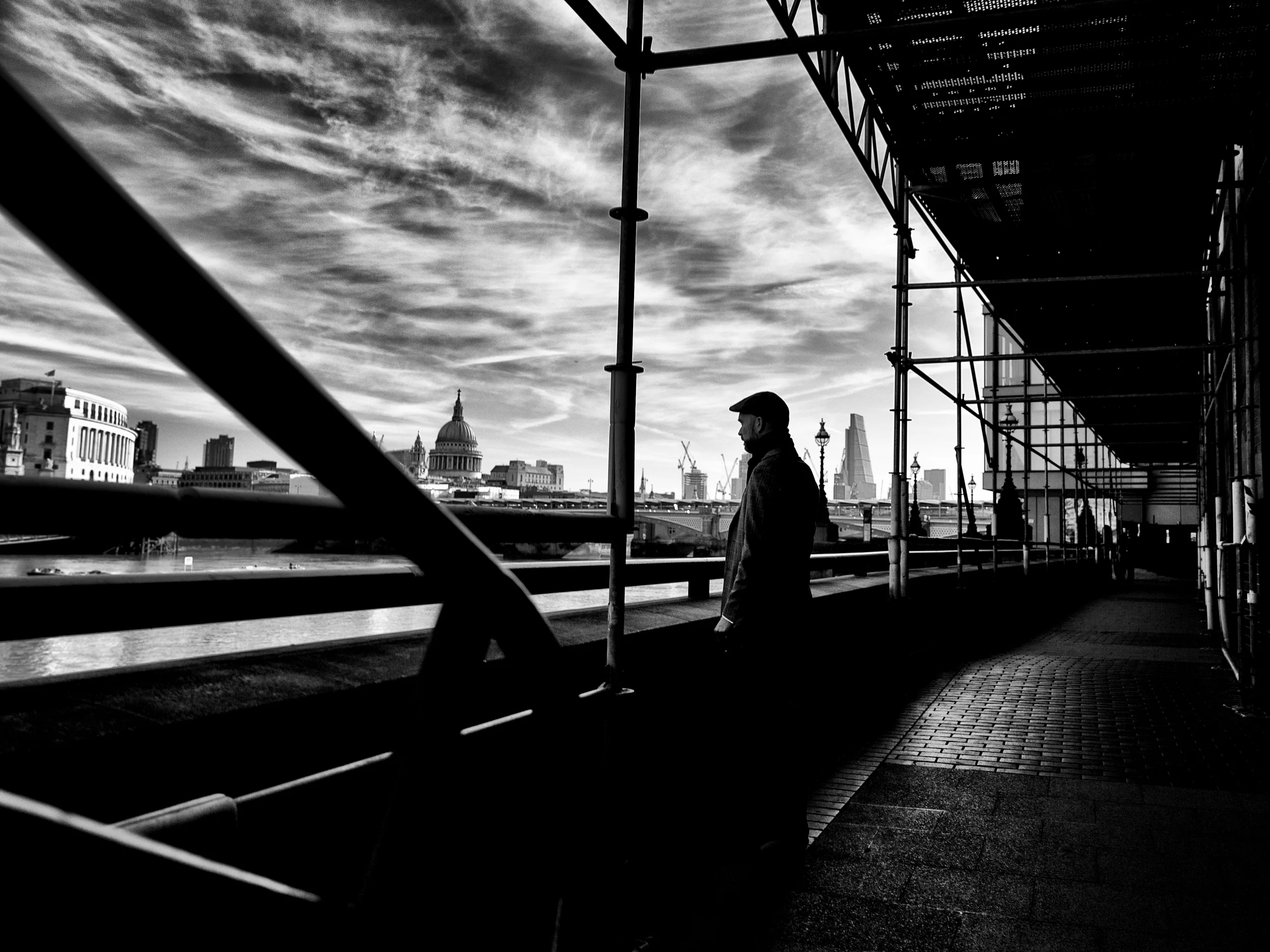
In April, I took a photograph of a man, wrapped warmly against the cold spring morning, standing on the south bank of the River Thames, looking across the water towards St Paul's Cathedral. I went on to take many other photos that morning, wandering the streets of the city as they began to fill, before heading home for lunch. A great way to spend a Sunday. I was already pleased with this one, along with half a dozen others that day.


In time, I posted a black and white version of the picture on a couple of social media sites and it seemed to get a good reaction, claiming photo of the day awards with a few Instagram sites. Then I submitted it to One Million Photographers - no real expectation of anything but hey... And it got Editor's Choice (thanks editor). That was a big boost. But nobody would know how to find more of my stuff - I needed a website. And if I needed a website, people told me, I needed a blog. So here it is.
I've always enjoyed words - heck, I almost had a children's book published once (almost) - but is anyone actually going to want to read the ramblings of an obsessive camera pointer who is sharpening his skills?
We shall see.